
Hypoallergenic vs. Fragrance-Free Laundry Products: What’s the Difference?
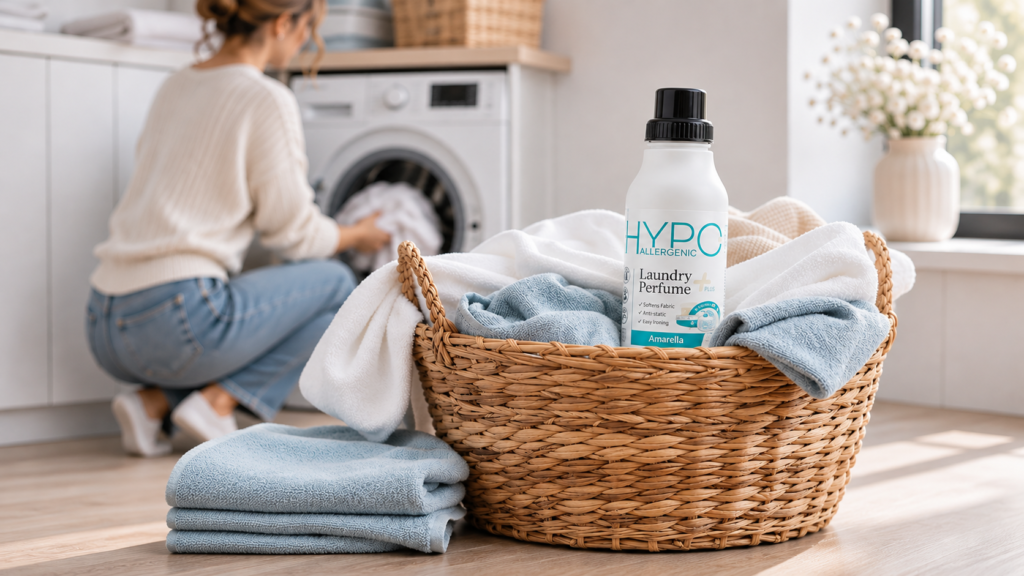
Hypoallergenic and fragrance-free describe different features of a laundry product. One concerns its potential to cause an allergic reaction. The other concerns the presence of fragrance ingredients. Understanding this distinction makes it easier to choose fabric care that fits your needs.
You might prefer a subtle scent, want to avoid added fragrance or need to account for a diagnosed allergy. Each situation calls for a slightly different approach. A useful starting point is to understand what the product does, what its description means and how to use it.
What does hypoallergenic mean in laundry care?
The term “hypoallergenic” is used to describe formulations developed with the aim of reducing the likelihood of an allergic reaction. It does not, by itself, tell you whether a product has a scent.
It also does not identify the product’s function. A hypoallergenic detergent, laundry perfume and crease spray serve different purposes, even when they share the same description.
For example, Amarella’s Hypoallergenic Care collection includes liquid laundry perfume, scent beads and crease care sprays. Choosing between them starts with the result you want: adding fragrance during washing or smoothing the appearance of wrinkles afterwards.
Does hypoallergenic mean suitable for everyone?
Individual tolerance varies, so no hypoallergenic description can guarantee that every person will tolerate a formula.
For everyday shopping, treat the term as one piece of information alongside the ingredients, intended use and directions. If you have a diagnosed allergy, check the product against the specific substances you have been advised to avoid.
Does hypoallergenic mean fragrance-free?
No. A product can have a fragrance and carry a hypoallergenic claim. Whether that claim is justified depends on the particular formulation and the evidence supporting it.
Fragrance-free describes a different characteristic. In the US Environmental Protection Agency’s Safer Choice programme, it means that the product contains no fragrance materials or masking scents. The EPA also explains that “unscented” products may contain ingredients that mask the smell of other ingredients.
The descriptions can be compared as follows:
| Description | What it tells you | What else to check |
|---|---|---|
| Hypoallergenic | The manufacturer makes a claim about the formula’s allergic potential | Information supporting the claim and the ingredients relevant to your needs |
| Fragrance-free | The product is described as containing no added fragrance materials | The manufacturer’s explanation and the rest of the formulation |
| Lightly scented | The fragrance is intended to have a subtle character | Ingredients, instructions and your own fragrance preferences |
These descriptions help answer different questions. “Does this contain fragrance?” and “Does this formulation suit my needs?” are both worth asking.
Can a hypoallergenic product have a pleasant scent?
Yes, the two characteristics are not mutually exclusive. A hypoallergenic description does not automatically mean that all fragrance ingredients have been excluded.
However, the character of the scent and the formulation should be considered separately. Words such as “soft”, “fresh” or “cotton-inspired” describe the fragrance experience. They do not establish how a particular person will tolerate the ingredients.
For someone with a diagnosed fragrance allergy, choosing around identified allergens takes priority over choosing a scent profile.
Sensitive skin and fragrance preferences: where should you start?
It helps to identify what you want to achieve before comparing products.
If you simply find strong fragrances overwhelming, you may prefer a more subtle scent or choose fragrance-free care. This is a matter of personal comfort and preference.
Sensitive skin is a broader consideration. It can involve sensations such as stinging, burning or itching and does not necessarily mean that a specific allergy has been diagnosed.
If you have a known allergy or a skin condition, use that information to guide your choice. For people with atopic dermatitis, the American Academy of Dermatology recommends fragrance-free and dye-free laundry detergent.
Persistent or recurring skin symptoms are worth discussing with a clinician. A product label can help you compare formulas, but it cannot identify the cause of a skin problem.
How to choose the right type of laundry product
Before looking at fragrance or other characteristics, check the product’s main purpose. This makes it easier to choose a useful addition to your routine.
Start with a detergent for cleaning
Detergent is the foundation of the wash. Choose one appropriate for your fabrics and household needs, then follow its dosing instructions.
The recommended amount may depend on the size of the load, the level of soiling and water hardness. Measure the dose using the guidance on the packaging.
In its advice for children with eczema, the American Academy of Dermatology highlights using the recommended amount of detergent and enough water for adequate rinsing
Choose fabric softener when you want softer fabrics
Fabric softener serves a different purpose from detergent and laundry perfume. It is used during rinsing to soften fabrics, while some formulas also help make ironing easier.
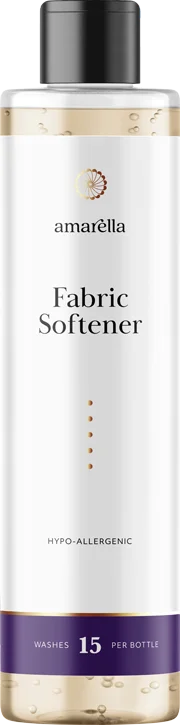
Amarella’s Fabric Softener has a hypoallergenic formula and is designed without a dominant scent. This makes it a useful example of why softening, fragrance intensity and hypoallergenicity should be considered separately.
Follow the product’s dosing instructions and check that fabric softener is suitable for the garment you are washing.
Choose fragrance when you want an added scent
Laundry perfume and scent beads offer ways to introduce fragrance into fabric care. They are optional additions, so choose them according to your preferences and any ingredient restrictions relevant to your household.
Liquid products and beads can have different application instructions. Check the label for where to add the product and how much to use.
For more guidance on liquid fragrance products, read how to use laundry perfume. The instructions for the specific product should always take priority.
Choose crease care for finishing
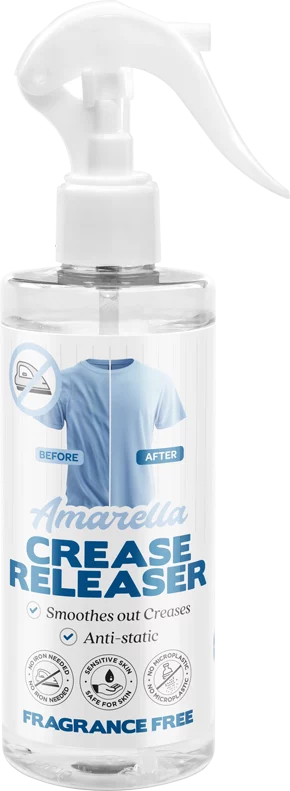
A crease spray has a different role. It is used to help smooth the appearance of wrinkles rather than clean the fabric.
This can be useful when you want to refresh the appearance of an outfit after storage or travel. Check the product instructions and the garment’s care requirements before application.
A fragrance-free crease spray may appeal to someone who wants this finishing step without adding another scent. It still needs to be assessed as a separate product, with its own ingredients and intended use.
What should you check before buying?
A short checklist can make comparisons easier without turning every purchase into a lengthy research exercise.
Check the exact product and fragrance. Information about one variant should not automatically be applied to every product in a range.
Read the directions. Look for the recommended dose, application method and any restrictions concerning fabrics.
Check ingredients relevant to your needs. This is particularly useful when you already know which substances you need to avoid. Ask the manufacturer if the available information does not answer a specific ingredient question.
Look at the meaning of supporting claims. If a description mentions testing or certification, check what it covers. The value lies in the information about the particular formula, assessment and result.
Other characteristics should be considered on their own terms. For example, a microplastic-free description concerns the composition of a product. It does not independently establish whether the complete formula will suit a particular person’s skin.
Exploring Amarella’s hypoallergenic and fragrance-free collections
Amarella separates its hypoallergenic and fragrance-free products into distinct collections. This makes it easier to browse according to the type of care you are looking for.
Hypoallergenic fabric softener
Amarella’s Fabric Softener brings the focus to softness and easier ironing. Its restrained scent is designed to leave room for the laundry fragrance you choose, if you want to add one.
The product complements the perfume, scent bead and crease care options described below. Each has a different function, so you can choose the steps that suit your fabrics and routine.
Liquid laundry perfume
Amarella’s Hypoallergenic Laundry Perfume offers the Smooth Cotton fragrance in a liquid format.
The cotton-inspired scent gives you a defined fragrance profile to consider, while the liquid format allows you to measure the amount specified in the instructions. It is an option for people who want an added laundry fragrance and have checked that the product fits their requirements.
Scent beads
The collection also includes Hypoallergenic Laundry Scent Beads in the Smooth Cotton fragrance.
They provide an alternative format for the fragrance step. Choose according to how you prefer to use the product, and follow the bead-specific directions rather than assuming they are applied in the same way as a liquid perfume.
Crease care with or without fragrance
Crease care sprays are also part of Amarella’s hypoallergenic range. Separately, the Fragrance-Free collection offers crease care without added fragrance.
The choice depends on the task. If you want fragrance during laundering, explore the perfume or beads. If you want to smooth wrinkles afterwards, look at crease care. You can select the steps that are useful for your clothes and routine.
Frequently asked questions
Are hypoallergenic and fragrance-free interchangeable terms?
No. They describe different characteristics. A hypoallergenic claim does not automatically establish that fragrance ingredients are absent, and fragrance-free does not mean that every remaining ingredient will suit every person.
Is a subtle fragrance the same as a hypoallergenic formula?
No. Subtlety describes the perceived character or intensity of a scent. A hypoallergenic claim concerns the formulation’s allergic potential and needs its own supporting evidence.
Are natural fragrances always a better choice for sensitive skin?
Natural origin alone does not establish suitability. Essential oils can contain substances that cause allergic contact dermatitis. Choose according to the specific formulation and your needs rather than assuming that “natural” guarantees tolerance.
Do I need to use detergent, fabric softener and laundry perfume together?
You need a suitable detergent to clean washable laundry. Additional products depend on the result you want and the instructions for your fabrics and chosen products. Laundry perfume does not replace detergent.
What is the most useful first step when comparing products?
Identify the function you need: cleaning, fragrance or crease care. Then compare the relevant products by their ingredients, directions and fragrance characteristics. This keeps your choice focused on what will be useful in your routine.
Keep reading
More from the blog
-
 Jak prać ręczniki, żeby były miękkie i świeże?
W ilu stopniach prać ręczniki? Zacznij od metki. Wytrzymałe ręczniki bawełniane możesz prać w 60°C, jeśli producent na to pozwala. Jeśli na…
-
How to wash towels so they stay soft and fresh
What temperature should you wash towels at? Start with the care label. Sturdy cotton towels can be washed at 60°C (140°F) if…
-
 Jak prać firanki, żeby się nie gniotły? Pranie i suszenie krok po kroku
Świeżo wyprane firanki potrafią sprawić, że całe pomieszczenie wygląda jaśniej i przytulniej. Samo usunięcie kurzu i zabrudzeń to jednak tylko część pielęgnacji.…